
Before you go: transit, timing, and money
Three practical things shape a Lisbon trip more than any single monument. Get them right and the itinerary below almost runs itself.
Getting in from the airport
Humberto Delgado Airport sits about 7 km from downtown. The Metro red line runs from under Terminal 1 for €1.90, roughly every 6–9 minutes from about 6:30 a.m. to 1:00 a.m. It does not reach the historic centre on its own — change at São Sebastião (blue line) or Alameda (green line), about 25–30 minutes to Baixa. A taxi or Bolt/Uber is roughly €10–15.
Getting around the city
Buy a reusable Navegante card (about €0.50) and load zapping pay-as-you-go credit (a metro ride is about €1.72), or the 24-hour Carris/Metro pass (about €7.25). If you'll visit several monuments, the Lisboa Card (from about €31 / 24 h) bundles 51 sites with unlimited transport, including trains to Sintra and Cascais. Note the historic Glória, Bica and Lavra funiculars have been closed since the September 2025 accident, so plan to walk the hills.
Timing, tickets and the tourist tax
Whatever the season, start early — Tram 28 and Sintra are both transformed by beating the crowds. Book timed-entry tickets(Pena Palace, Belém Tower, Quinta da Regaleira) ahead of time. Budget for Lisbon's municipal tourist tax of €4 per person per night (ages 13+, up to 7 nights), added to your accommodation bill. Cards work almost everywhere, but carry a little cash for small cafés and tips.
Day 1 · Centre & western hill
Baixa, Chiado, and sunset over Bairro Alto
Ease in on the flat. The Baixa — Lisbon's grid of downtown streets rebuilt after the 1755 earthquake — is the one part of the city you can cross without climbing, and it flows naturally uphill into the cafés of Chiado and the bars of Bairro Alto. Spend your first day on this compact loop, finishing at a west-facing miradouro (viewpoint) as the light goes gold.
Getting there
Everything is on foot. Start at Praça do Comércio, the grand riverside square, or take the Metro (blue or green line) to Baixa-Chiado. From there the whole day is a slow uphill loop into Chiado and Bairro Alto and back.
Praça do Comércio & Rua Augusta Arch
Lisbon's showpiece square, open to the Tagus on one side and framed by the triumphal Rua Augusta arch on the other. Free to wander; a small fee to climb the arch for a view down the Baixa grid. Walk north up pedestrian Rua Augusta into downtown.
Chiado & the oldest bookshop in the world
Lisbon's elegant shopping and café quarter. Livraria Bertrand (open since 1732) holds the Guinness record as the world's oldest operating bookshop, and A Brasileira café out front has served coffee since 1905. A gentle, browsable stretch.
Carmo Convent & the Santa Justa viewpoint
The roofless Gothic arches of the Carmo Convent — left ruined by the 1755 earthquake — are one of the city's most atmospheric sights. The neighbouring Santa Justa Lift's rooftop terrace looks out over the Baixa; smart tip: you can reach the same terrace on foot from Largo do Carmo instead of queuing for the lift (confirm current status, as the viewpoint has had rehabilitation works).
Bairro Alto & a miradouro sunset
The Miradouro de São Pedro de Alcântara looks across the valley to the castle — a classic spot to watch the sun set. Note the historic Glória funicular that once climbed here has been closed since 2025, so walk up. Afterwards, Bairro Alto's lanes fill with small bars and Fado houses after dark.
For dinner, drop down to the Time Out Market (Mercado da Ribeira) by Cais do Sodré — dozens of stalls from Lisbon's best-known chefs under one roof — a natural, downhill end to the day.
Day 2 · Eastern hill (Alfama)
The castle, the old Moorish quarter, and Tram 28
Alfama is Lisbon's oldest neighbourhood — a tangle of stepped lanes, laundry lines and Fado that survived the earthquake almost intact, wrapped around the hill under São Jorge Castle. The trick is to go up first and let gravity do the rest, walking down through the maze rather than climbing it. This is also Tram 28 country, so time that ride for early morning.
Getting there
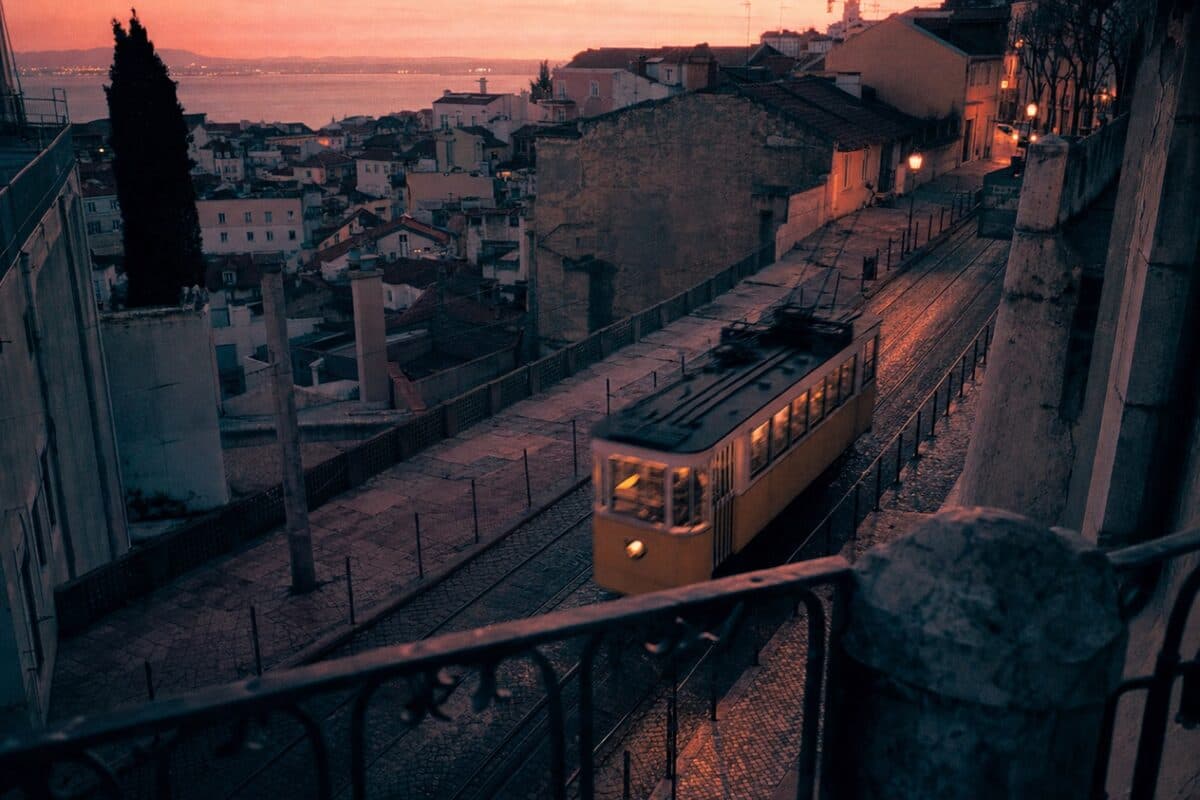
Ride the vintage Tram 28E, but board at the Campo de Ourique (Prazeres) end rather than the packed Martim Moniz terminus — you go against the crowd and actually get a seat. Or take a bus/tuk-tuk up to the castle and walk down. Everything in Alfama after that is on foot, mostly downhill.
Castelo de São Jorge
The Moorish castle crowning the hill, with ramparts, peacocks, and the best wide view over the city and river. Adult admission about €17 (youth 13–25 €8.50, seniors €14). Open daily — roughly 9:00 a.m.–9:00 p.m. in summer, 9:00 a.m.–6:00 p.m. in winter. Go early for the light and the quiet.
Sé Cathedral & the Alfama lanes
From the castle, wander down through Alfama. The fortress-like Sé (Lisbon's cathedral) anchors the lower slope; between it and the castle the streets are a photogenic maze — let yourself get a little lost.
Miradouros das Portas do Sol & Santa Luzia
Two adjacent terraces looking out over Alfama's rooftops to the Tagus — the postcard view of the neighbourhood, and free. A good place to pause with a coffee mid-descent.
Fado in the evening
Alfama is the birthplace of Fado, Portugal's melancholic sung music (a UNESCO cultural treasure). A small Fado house for dinner is the classic way to end the day; the nearby Fado Museum gives the background if you want it.
One safety note: Tram 28 is Lisbon's most-targeted pickpocket line, especially in the boarding scrum at Martim Moniz and through the Sé. Keep your bag in front of you and your phone zipped away. If Tue or Sat, the Feira da Ladra flea market at Campo de Santa Clara is a short walk on.
Day 3 · Riverfront (west)
Belém — monuments, monsters, and the original custard tart
Belém is where Portugal launched the Age of Discovery, and its monuments line the river a few kilometres west of the centre. Because everything sits within a flat 15-minute walk of everything else, it is the easiest cluster to plan — with one 2026 catch worth knowing before you go: Belém Tower now runs on timed entry.
Getting there
Take Tram 15E from Praça da Figueira, or the CP Cascais-line train from Cais do Sodré (Belém is a stop) — about 20–25 minutes either way. The main sights then line the riverfront within a short walk of each other.
Jerónimos Monastery
A UNESCO World Heritage masterpiece of Manueline stonework and the highlight of Belém. Open Tuesday–Sunday 9:30 a.m.–5:30 p.m. (last entry 5:00 p.m.), closed Mondays; cloister admission about €18, the church free. Book online — queues can run past an hour in high season.
Belém Tower (Torre de Belém)
The fairytale riverside fortress reopened on 27 May 2026 after a year of restoration — and now uses a new timed-entry system capped at 60 visitors every 30 minutes (about 900 a day). Open 9:30 a.m.–5:30 p.m. (last entry 5:00 p.m.), closed Mondays; admission about €15. Buy your timed slot online or at the Jerónimos ticket office before you arrive.
Padrão dos Descobrimentos
The Monument to the Discoveries — a 52-metre limestone prow of explorers pointing at the river. Climb it for a view over Belém and the giant compass-rose map on the plaza below.
Pastéis de Belém
The original custard tarts, baked to a secret 1837 monastery recipe on this exact spot. Expect a line; the fast-moving one to the right is for the sit-down room, where warm tarts arrive dusted with cinnamon. This is the one queue in Lisbon worth joining.
With time to spare, the MAAT art-and-architecture museum and the LX Factory — a converted industrial complex of bookshops, cafés and street art — are both a short hop back toward the centre. Because Belém sits on the Cascais train line, an energetic traveller can also fold a short afternoon in Cascais into the same westbound day.
Day 4 · Day trip (northwest)
Sintra — palaces on misty hills, and the classic routing trap
Sintra is the day trip everyone takes and the one first-timers most often get wrong. Its palaces and gardens are scattered across separate forested hilltops, connected only by looping buses and steep footpaths — so the mistake is trying to see all five in a day and enjoying none of them. Pick two or three, book the timed ones ahead, and start early.
Getting there
Take the CP Sintra Line train from Rossio Station — about 40 minutes, roughly €2.30 each way, every 20 minutes (and free with the Lisboa Card). From Sintra station the 434 'Pena Circuit' bus climbs to the castles; a hop-on-hop-off day pass (434 + 435) is about €13.50.
Pena Palace
The candy-coloured royal palace on the highest hill — Sintra's icon. Park + Palace admission about €20 (youth/seniors €18); palace entry is timed, so you must book a specific date and time online. After you validate at the park gate it is a further ~30-minute walk uphill to the palace (or a €4.50 return shuttle). Aim for an early slot before the coaches arrive.
Castle of the Moors (Castelo dos Mouros)
A 10th-century Moorish hilltop fortress whose ramparts snake along the ridge with sweeping views — a short hop from Pena on the 434 loop, and a fine second stop if you want a walk between palace visits.
Quinta da Regaleira
A Neo-Manueline estate of grottoes, towers and hidden symbolism, famous for the spiral Initiation Well you descend underground. Adult admission about €20 (youth/seniors €15), timed entry from 10:00 a.m. — book online, and consider heading straight for the well before the tour buses reach it.
Do not attempt Pena, the Moorish Castle, Regaleira, the National Palace and Monserrate in one day — it is the classic over-packed Sintra plan that ends in exhaustion. Two headline sights plus a wander through Sintra Vila is a full, satisfying day. Aim to catch a train back around 5–6 p.m.
Routing traps and how to pace it
Lisbon rewards a plan that thinks about distance and elevation, not just a list of sights. Two mistakes trip up almost every first-timer, and both are easy to avoid once you can see the day laid out on a map.
| If you feel... | Do this |
|---|---|
| Tempted to cram all of Sintra into one day | Pick two headline sights (say Pena plus Regaleira) and a wander through Sintra Vila. Trying to add the Moorish Castle, the National Palace and Monserrate too is the classic over-packed plan that ends in exhaustion. |
| Worn out by the hills mid-trip | Swap an afternoon for the flat riverfront — the Time Out Market, a Tagus-side walk, or the Cascais train — and let the miradouros come to you at sunset instead of chasing them all. |
| You'd rather skip a second day trip | Since Belém sits on the Cascais train line, you can fold a short, easy Cascais beach afternoon onto your Belém day rather than spending a whole separate day on it. |
The other quiet upgrade is context. A monument you understand is a monument you remember — so before Belém or Quinta da Regaleira, it helps to have the history of the Discoveries or the estate's hidden symbolism in your ears rather than reading a plaque in a crowd.
Plan it with HipiMind
Plan this trip by talking
An itinerary like this is easy to read and surprisingly hard to hold in your head — which day was Belém, and does the Sintra plan actually fit? That is exactly what HipiMind is built for. It is a voice-first AI travel assistant: describe your Lisbon trip out loud — “four days, first time, we like history and food, hate rushing” — and it turns the conversation into a day-by-day itinerary with every stop placed on a map. When a Sintra day secretly packs in five hilltop palaces, or a plan bounces from Alfama in the east to Belém in the west and back, you see it on the map and can say “fix that” before you're standing at a bus stop.
For the sights themselves, ask HipiMind to generate a long-form audio guide about Lisbon — the Age of Discovery behind the Jerónimos Monastery, the story of Fado in Alfama, the Masonic symbolism of Quinta da Regaleira — and listen hands-free on the Sintra train or as you climb to the castle. It is interruptible: pause to ask a question, get an answer, and resume where you left off. It plans and narrates in the language you speak, across 32 languages, right in the browser — no app to install.
The free tier includes 3 voice sessions and 1 audio guide per calendar month. HipiMind Plus is $7.99/month ($59/year) with 60 voice sessions, 20 audio guides, and full trip memory across journeys. HipiMind plans and narrates — it does not book trains, hotels, or timed-entry tickets, and it is not a GPS-triggered on-site tour; confirm times, prices, and reservations with the provider.
Lisbon itinerary FAQ
Is 4 days enough for Lisbon as a first-timer?
Yes. Four days comfortably covers Lisbon's core — the Baixa and Chiado, Alfama with São Jorge Castle, and the Belém monuments — plus a full day trip to Sintra, without rushing. The key is grouping each day by hill so you walk gentle loops instead of climbing the same slopes twice.
What is the best way to get around Lisbon in 2026?
Get a reusable Navegante card (about €0.50) and load it with 'zapping' pay-as-you-go credit (a metro ride is about €1.72), or buy the 24-hour Carris/Metro pass for about €7.25. If you plan to visit several monuments, the Lisboa Card (from about €31 for 24 hours) bundles entry to 51 sites with unlimited transport, including the trains to Sintra and Cascais. Note that the historic Glória, Bica and Lavra funiculars have been closed since the September 2025 accident.
How do I get from Lisbon Airport to the city centre?
The Metro red line runs directly from under Terminal 1 for €1.90, roughly every 6–9 minutes from about 6:30 a.m. to 1:00 a.m. The red line does not reach the historic centre on its own, so change at São Sebastião (for the blue line to Baixa/Avenida) or Alameda (for the green line to Alfama and Baixa) — about 25–30 minutes to downtown. A taxi or Bolt/Uber is roughly €10–15.
Do I need to book Sintra tickets in advance?
Yes for Pena Palace, which uses timed entry — you choose a date and time when you book, and there is no tolerance for arriving late. Quinta da Regaleira also uses timed slots. Just as important: don't try to see all five Sintra sights in one day. Pick two or three, book those, and you'll actually enjoy them.
When should I ride Tram 28, and is it safe?
Ride it before 9 a.m. or after 7 p.m. — at midday from spring to autumn it is standing-room-only with 30–45 minute queues. Board at the Campo de Ourique (Prazeres) terminus to go against the crowd and get a seat. Tram 28 is also Lisbon's number-one pickpocket line, especially in the Martim Moniz boarding scrum and through the Sé, so keep bags in front of you and phones zipped away.
Is Belém Tower open in 2026?
Yes. Belém Tower reopened on 27 May 2026 after a year-long restoration, with a new timed-entry system capped at 60 visitors every 30 minutes (about 900 a day). It is open 9:30 a.m.–5:30 p.m. (last entry 5:00 p.m.) and closed Mondays, like the nearby Jerónimos Monastery. Buy a timed ticket online or at the Jerónimos ticket office before you go.
How can HipiMind help me plan a Lisbon trip?
HipiMind is a voice-first AI travel assistant: describe your Lisbon trip out loud and it turns the conversation into an editable, day-by-day itinerary with every stop on a map, so you can immediately see when a plan crosses the city or over-packs Sintra — and fix the route before you go. It can also generate a long-form audio guide about Lisbon, Belém's Age of Discovery, or the symbolism of Quinta da Regaleira, to listen to hands-free on the train. It does not book trains, hotels, or timed tickets — confirm those with the provider.
Sources
Opening hours, fares, and admission figures in this guide were grounded in the following official and authoritative sources (checked July 2026). Details change seasonally — verify before you travel.
- Lisboa Card — official prices & inclusions
- Carris — occasional fares & Tram 28 (official)
- Metropolitano de Lisboa — tickets & airport line (official)
- Parques de Sintra — Pena Palace tickets (official)
- Quinta da Regaleira — 2026 entrance fees (official)
- Jerónimos Monastery — hours & tickets (official)
- Castelo de São Jorge — tickets & schedules (official)
- Lisboa City Council — €4 municipal tourist tax (official)
- The Portugal News — Belém Tower reopens with timed entry (May 2026)
- Reuters — Lisbon funicular closed after 2025 crash