
Before you go: transit, money, and timing
Three practical things shape a Marrakech trip more than any single palace. Get them right and the itinerary below almost runs itself.
Getting in from the airport
Marrakech Menara (RAK) is only about 6 km out. The L19 'Airport Express' bus is a flat 30 MAD to the Koutoubia/Jemaa el-Fna edge of the medina, roughly every 20–30 minutes from about 6:00 a.m. to 11:30 p.m. A regulated petit taxiis roughly 70–100 MAD by day (a ~50% night supplement applies), though drivers often open at 150–300 MAD — agree the fare in dirhams first, or use the airport's kech.cab prepaid counter. Many riads sit down car-free alleys, so message yours ahead for the exact drop-off point.
Money and tickets
The dirham (MAD) is a closed currency — hard to buy before you arrive — so plan to withdraw from an ATM on landing and carry cash: the souks and every monument gate are cash-only. The one big exception to book online is the Majorelle Garden, whose timed tickets are sold through its official site only. Budget roughly 50–100 MAD per monument.
Timing and Ramadan
Most monuments open around 9:00 a.m., so start early to beat both the tour groups and the midday heat. Spring and autumn are ideal; summer in the souks is punishing. In 2026, Ramadan runs roughly February 17 to March 19— sights stay open but on reduced hours, and the city's daytime rhythm is quieter, with Jemaa el-Fna liveliest after dark.
Day 1 · Medina heart
Jemaa el-Fna, the Koutoubia, and the souks
Spend your first day at the centre of gravity. Almost every lane in the old city eventually leads back to Jemaa el-Fna, so learning this square and the souks north of it is the orientation that makes the rest of the trip easy. The plan is a slow loop on foot — square, minaret, souks, and back to a rooftop as the square transforms at dusk.
Getting there
Everything is on foot. If you arrive today, the L19 'Airport Express' bus drops you beside the Koutoubia, a few minutes' walk from the square. Learn three landmarks — the Koutoubia minaret, Jemaa el-Fna, and your riad's nearest gate — and you can always find your way home.
Koutoubia Mosque (from outside)
The 12th-century minaret is Marrakech's tallest landmark and its main compass point. Like most active mosques in Morocco, it is closed to non-Muslims, but the exterior and the free rose gardens beside it are open to everyone — best in the late-afternoon golden hour.
The souks
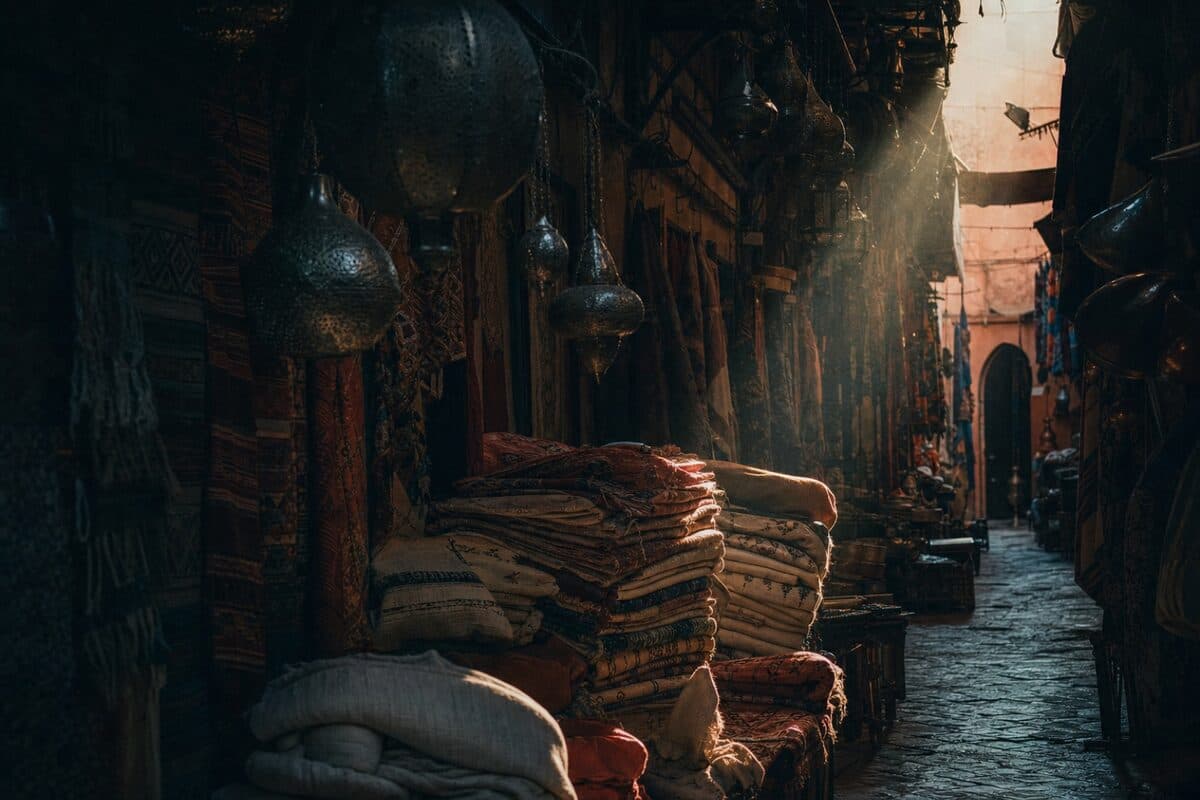
The covered market lanes fan out north of the square — leather in one derb, lanterns and copper in another, slippers, spices and carpets beyond. Get pleasantly lost, but agree a price before you commit to anything, and treat 'the souk is closing, follow me' as the opening line of a sales pitch, not a fact.
A rooftop at sunset
Café de France and Café Glacier are the classic terraces overlooking Jemaa el-Fna. Order a mint tea and watch the square fill as the light goes: this is the moment the day version (dusty, a little touristy) becomes the night version everyone remembers.
Jemaa el-Fna after dark
A UNESCO 'Masterpiece of the Oral and Intangible Heritage of Humanity.' After sunset the food stalls, storytellers, gnaoua musicians and orange-juice carts take over. Eat where it is busy with locals, keep your bag in front of you in the crush, and settle prices before you sit.
This is a deliberately light first day: no ticketed sites, just orientation and atmosphere. It leaves you fresh for the palaces tomorrow — and once you can picture the square and the souks, the medina stops feeling like a trap and starts feeling like a place you know.
Day 2 · Southern medina (the Kasbah & Mellah)
The Kasbah palaces and the Saadian Tombs
Marrakech's grandest monuments cluster in the south of the medina, in the old royal Kasbah and the neighbouring Mellah. Because they sit within a short walk of one another, this is the easiest day to plan as a single loop — and the one where an early start pays off most, both for the light and to beat the coach groups.
Getting there
On foot from Jemaa el-Fna, it is about 10–15 minutes south to Bahia Palace; the Saadian Tombs and El Badi Palace are then a few minutes apart in the Kasbah quarter. A petit taxi from the square is 15–20 MAD if you would rather not walk in the heat — insist on the meter.
Bahia Palace
A 19th-century grand vizier's palace of painted cedar ceilings, zellij courtyards and a famous harem wing. Open daily about 9:00 a.m.–5:00 p.m. (roughly 10:00 a.m.–4:00 p.m. during Ramadan), last entry ~30 minutes before closing; foreign-adult admission about 100 MAD, cash only at the gate. Arrive at opening — the courtyards are silent and the low sun lifts the stucco.
El Badi Palace
The 'Incomparable Palace' of Sultan Ahmad al-Mansur, now a vast sunken ruin patrolled by nesting storks — atmospheric in a completely different way to Bahia. Open daily ~9:00 a.m.–5:00 p.m. (Ramadan ~10:00 a.m.–4:00 p.m.), about 100 MAD for foreign adults, cash only.
Saadian Tombs
The Saadian dynasty's mausoleum, sealed behind a wall around 1672 and lost for nearly 250 years until a 1917 aerial survey rediscovered it. Open daily ~9:00 a.m.–5:00 p.m. (Ramadan ~10:00 a.m.–4:00 p.m.), about 100 MAD. It closes briefly for Friday midday prayers at the adjacent Kasbah Mosque, and a queue builds for the finest chamber — go first thing.
The Mellah & the spice square
The historic Jewish quarter sits just east of Bahia, with its restored synagogue and the aromatic Rahba Kedima (spice and apothecary square) on the way back toward the souks — a natural, backtrack-free thread north to end the day.
Three monument tickets in a morning is plenty of ornamented plaster for one day. Keep the afternoon loose for the Mellah, a long lunch, or a hammam — the traditional steam-and-scrub that is one of the best things to do with tired feet in Marrakech.
Day 3 · Northern medina + Guéliz
Ben Youssef, a hidden garden, and Majorelle
Day 3 splits into two halves that catch the classic first-timer routing mistake. The northern medina — Ben Youssef and Le Jardin Secret — is a tight morning cluster on foot. The Majorelle Garden, though, is out in the new town of Guéliz, well beyond the walls, so the trick is to treat it as the anchor of a relaxed Guéliz afternoon rather than a there-and-back dash from the square.
Getting there
Morning on foot in the north medina (Ben Youssef is about a 15-minute walk from Jemaa el-Fna). Then a 10-minute, ~30–50 MAD petit taxi out to Majorelle in Guéliz for the afternoon — cluster it with the museum and Guéliz's cafés instead of darting back to the medina in between.
Ben Youssef Madrasa
Once North Africa's largest Quranic college, reopened in April 2022 after a multi-year restoration that left the carved cedar, stucco and zellij crisper than they have looked in decades. Open daily 9:00 a.m.–7:00 p.m. (9:00 a.m.–4:30 p.m. in Ramadan); about 50 MAD for foreign adults, tickets sold on-site only. The reflecting basin in the courtyard is most photogenic in morning light.
Le Jardin Secret
A restored 19th-century riad garden on Rue Mouassine, a calm green pause in the middle of the souks with a climbable tower for rooftop views. Open daily from 9:30 a.m. (closing shifts with the season, roughly 6:00–7:30 p.m.); about 100 MAD entry, plus 40 MAD for the tower.
Dar el Bacha & the north souks
On the walk between Ben Youssef and Mouassine, the Dar el Bacha palace-museum (and its much-Instagrammed Bacha Coffee room) makes an easy add — and the quieter northern souks around Mouassine are better for actually buying than the tourist-thronged central lanes.
Jardin Majorelle & the YSL Museum (Guéliz)
The cobalt-blue garden the painter Jacques Majorelle created and Yves Saint Laurent later saved — Morocco's most-visited site. Garden open daily ~8:00 a.m.–6:30 p.m.; garden-only admission for foreign adults is about 170 MAD, with combined tickets for the Berber Museum and the YSL Museum (open daily except Wednesday). Critical: buy timed tickets from the official site, tickets.jardinmajorelle.com, only — not from resellers.
Because you are already in Guéliz, the Yves Saint Laurent Museum next door and the district's leafy cafés make a natural, unhurried end to the afternoon — far better than fighting back through the souks twice in one day.
Day 4 · Beyond the walls (day trip)
The Atlas Mountains, the Agafay, or Essaouira
Marrakech sits within reach of three completely different day trips, and picking one is a better day than trying to see more of the same medina. Choose by the mood you are missing: mountains and greenery, cinematic desert, or Atlantic sea air.
Getting there
All three are easiest as an organised day tour with a driver, booked through your riad or a reputable operator. Rough one-way travel times: the High Atlas foothills (Imlil / Ourika Valley) about 1–1.5 hours; the Agafay Desert about 45 minutes; Essaouira on the coast about 2.5–3 hours.
The High Atlas: Imlil or the Ourika Valley
The classic escape — Berber villages, terraced fields and waterfalls under North Africa's highest peaks. Imlil is the gateway for walks toward Toubkal; the Ourika Valley (Setti Fatma) is the greener, waterfall-and-riverside option. Spring brings snow on the summits above green foothills. Full-day 4x4 or minibus tours run roughly €25–60 per person.
The Agafay Desert
Not true Sahara dunes but a dramatic stony desert of rolling hills, only about 45 minutes from the city — close enough for a half-day of camel or quad rides, a Berber lunch, or a sunset dinner at a desert camp before heading back the same night.
Essaouira
A breezy, blue-and-white Atlantic port with a walkable UNESCO ramparts medina, a working fishing harbour, and gnaoua music in its DNA — a complete change of pace and temperature. It is a long day at ~2.5–3 hours each way, so leave early and treat the drive as part of it.
If you would rather not travel again, spend the day back inside the walls: a slow hammam, the Musée Yves Saint Laurent or the Maison de la Photographie, and the parts of the souk you saved for last. A fourth day is also permission to do less.
Plan it with HipiMind
Plan this trip by talking
An itinerary like this is easy to read and surprisingly hard to hold in your head — which day was the Kasbah, and does the Majorelle plan actually fit? That is exactly what HipiMind is built for. It is a voice-first AI travel assistant: describe your Marrakech trip out loud — “four days, first time, we like history and markets, hate rushing” — and it turns the conversation into a day-by-day itinerary with every stop placed on a map. When a day secretly darts from the medina out to Majorelle in Guéliz and back, or scatters the Kasbah palaces across two afternoons, you see the long leg on the map and can say “fix that” before you're haggling with a taxi.
For the sights themselves, ask HipiMind to generate a long-form audio guide about Marrakech — the rise of the Saadian dynasty behind the tombs, the trades of the souks, the story of Ben Youssef — and listen hands-free as you wander. It is interruptible: pause to ask a question, get an answer, and resume where you left off. It plans and narrates in the language you speak, across 32 languages, right in the browser — no app to install.
The free tier includes 3 voice sessions and 1 audio guide per calendar month. HipiMind Plus is $7.99/month ($59/year) with 60 voice sessions, 20 audio guides, and full trip memory across journeys. HipiMind plans and narrates — it does not book riads, transfers, or tickets, and it is not a GPS-triggered on-site tour; confirm times, prices, and reservations with the provider.
Marrakech itinerary FAQ
Is 4 days enough for Marrakech as a first-timer?
Yes. Four days comfortably covers the medina's core — Jemaa el-Fna and the souks, the Kasbah palaces and the Saadian Tombs, Ben Youssef and the northern medina — plus the Majorelle Garden in Guéliz and a full day trip to the Atlas Mountains, the Agafay Desert or Essaouira. The key is grouping each day by quarter so you loop through the maze instead of crossing it twice.
How do I get from Marrakech airport to the medina in 2026?
Marrakech Menara (RAK) is only about 6 km out. The cheapest option is the L19 'Airport Express' bus, a flat 30 MAD to the Koutoubia/Jemaa el-Fna edge of the medina, running roughly every 20–30 minutes from about 6:00 a.m. to 11:30 p.m. A regulated petit taxi is roughly 70–100 MAD in the daytime (a ~50% supplement applies at night), though drivers at the rank often open at 150–300 MAD — agree the fare in dirhams before you get in, or use the airport's kech.cab prepaid counter. Many riads sit down car-free alleys, so message yours in advance for the exact drop-off point.
Do I need to book tickets in advance?
Mostly no. Bahia Palace, El Badi Palace, the Saadian Tombs and Ben Youssef Madrasa all sell cash-only tickets at the gate, with no online booking. The important exception is the Majorelle Garden, which sells timed tickets through its official site (tickets.jardinmajorelle.com) only — buy there rather than from a third-party reseller, and pick a slot in advance in high season.
How do I avoid the Marrakech medina scams?
There are four common ones, none dangerous — they target your wallet. Fake guides approach near a gate, say 'it's closed, this way,' walk you somewhere unasked and then demand payment. Henna artists grab your hand and start a design before you agree a price. Snake and monkey handlers drape an animal on you for a 'free' photo, then charge for it. And some taxi drivers refuse the meter. The response to all four: decline unsolicited help with a firm 'la, shukran,' never let anyone touch you or your hand before a price is agreed, and insist on the meter. Real guides carry an official ONMT badge — or just book one through your riad.
Can I go inside the Koutoubia Mosque?
No. Like most active mosques in Morocco, the Koutoubia is closed to non-Muslims. You can admire the 12th-century minaret and walk the free gardens beside it from the outside, which is what most visitors do. (The Hassan II Mosque in Casablanca is the well-known exception that admits non-Muslims on guided tours.)
What is Marrakech like during Ramadan in 2026?
Manageable and, in the evenings, atmospheric. In 2026 Ramadan runs roughly February 17 to March 19, with Eid al-Fitr around March 20. Monuments, riads and tourist-facing restaurants stay open but on reduced hours (many sites shift to about 10:00 a.m.–4:00 p.m.), and Jemaa el-Fna comes alive after sunset with local families. Eat and drink discreetly during daylight and expect a quieter, more local daytime rhythm.
How can HipiMind help me plan a Marrakech trip?
HipiMind is a voice-first AI travel assistant: describe your Marrakech trip out loud and it turns the conversation into an editable, day-by-day itinerary with every stop on a map, so you can immediately see when a day zig-zags across the medina or darts out to Majorelle and back — and fix the route before you go. It can also generate a long-form audio guide about Marrakech — the Saadian dynasty, the story of the souks, the history behind Ben Youssef — to listen to hands-free. It does not book riads, transfers, or tickets — confirm those with the provider.
Sources
Opening hours, fares, and admission figures in this guide were grounded in the following official and authoritative sources (checked July 2026). Details change seasonally — verify before you travel.
- Ben Youssef Madrasa — official hours & prices
- Bahia Palace — Moroccan Ministry of Culture ticket office (official)
- Jardin Majorelle — official ticket office & opening hours
- Musée Yves Saint Laurent Marrakech (official)
- Le Jardin Secret — official tickets & hours
- Saadian Tombs — opening hours
- Unlimited Marrakech — airport taxis, L19 bus & 2026 fares
- UK FCDO — Morocco travel advice (safety & scams)
- Morocco Escape — travelling Morocco during Ramadan 2026